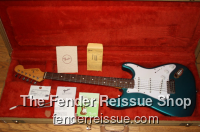
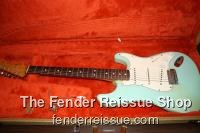
When Fender moved production from Fullerton to its new Corona, California facility in early 1985, the American Vintage Reissue Stratocaster program continued without interruption — but with subtle and important changes. Corona-era AVRI reissues represent the broadest collecting field within the V-prefix lineage: a span of nearly four decades, multiple specification revisions, and the eventual transition into the Custom Shop's Time Machine line and beyond. For collectors evaluating these guitars, the Corona era requires familiarity with how the line evolved, what specifications drifted from Fullerton-era construction, and where the most desirable examples sit. This page documents the Corona-era reissue in depth: the move to Corona, the changes to the '57 and '62 specifications, the V-serial number system as it expanded, the identification markers that authenticate a Corona-era example, and the reasons collectors continue to pursue the best of these guitars. For background on the broader reissue program, see our AVRI Stratocaster collector's guide.
The Move to Corona — Fender's New Chapter
By 1984, Fender's leadership recognized that the aging Fullerton facility could not support long-term high-quality production. A new plant was constructed in Corona, California, and production transferred during the first weeks of 1985. The Corona plant brought modern manufacturing tooling and significantly more controlled processes than Fullerton had managed in its final decades. For the AVRI line, this meant tighter tolerances, more consistent finishes, and reduced production variation — but also some specification drift over time. The earliest Corona-era reissues (1985 through 1988) are nearly indistinguishable from Fullerton-era examples in spec, while later Corona production (1990s onward) introduced incremental refinements: revised neck profiles, occasional changes in pickup construction, and the parallel introduction of the Custom Shop reissue line.
1957 and 1962 Reissues in the Corona Era
Corona-era '57 reissues retained the maple neck, soft V profile, eight-screw pickguard, and three '57-style single-coil pickups characteristic of the original specification. Pickup baseplates transitioned to gray-bottom only by 1985. The body remained alder with a two-tone Sunburst nitrocellulose finish as the standard option, with custom colors offered intermittently and in smaller quantities than the parallel '62 line. Late 1980s and early 1990s production show a slightly larger range of neck profile variation, and pots transitioned to slightly different CTS code formats over the period.
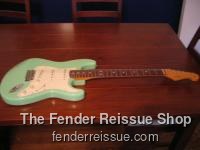
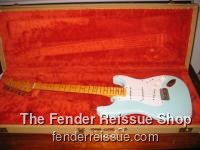
Corona-era '62 reissues continued with the slab rosewood fingerboard, modern-C profile, and '62-style pickup voicings, with custom colors continuing to be a major draw. Lake Placid Blue, Fiesta Red, Sonic Blue, Olympic White, Sherwood Green, Vintage White, and other Custom Color options were offered throughout the era, with production volume varying year to year. Custom-color Corona examples from the late 1980s and very early 1990s are particularly sought after by collectors, as Fender's specification was still tightly aligned with the Fullerton precedent during that window.
How to Identify a Corona-Era AVRI Stratocaster
Corona-era reissues continued the V-prefix serial number sequence inherited from Fullerton. As a rough guide, serials roughly V020000 through V100000 and beyond correspond to Corona-era production from 1985 through the 1990s. Numbering remained sequential across all V-serial Fender instruments, not just Stratocasters, so a P-Bass and a Strat in close production proximity can share neighboring serials. For year estimation from a specific serial, use The Fender Reissue Shop's AVRI serial number lookup tool — neighbor-bracketed estimates from documented inventory are tighter than any published serial-to-year chart.
Neck date format on Corona-era reissues changed gradually. Hand-stamped M-D-YY format continued through the late 1980s; by the early 1990s the date was often printed and accompanied by a model code prefix. The neck date is still located at the heel of the neck, and it remains the single most reliable piece of internal dating information. Pots continued to use the CTS six- or seven-digit code into the 1990s, where the first three digits identify the manufacturer (137 for CTS) and the last four indicate year and week of production. Body dates moved from penciled handwriting toward stamped or printed formats over the era, located in the neck pocket.
Corona-era construction is generally tighter than Fullerton — fewer hand-finishing inconsistencies, more uniform fret work, and more consistent neck pocket fit. This is a feature, not a defect: it reflects the modern plant's improved tooling. Tremolo blocks remained cold-rolled steel through the late 1980s, with diecast blocks introduced for some lower-tier reissue models in later years. The AVRI line itself maintained the steel block; inspect any guitar offered as a true AVRI to confirm that the block, hardware, and original-issue tweed case are consistent with the period.
Why Corona-Era Reissues Matter to Collectors
The Corona era provides the broadest and deepest collector field within the AVRI program. Late 1980s and very early 1990s examples — spec-aligned with Fullerton, with the eight-screw pickguard, period-correct hardware, and nitrocellulose finishes — are the most directly comparable to Fullerton-era guitars and trade at corresponding premiums. Custom-color Corona reissues, particularly in Lake Placid Blue, Fiesta Red, and Sonic Blue, are among the most desirable production Stratocasters Fender has built since the original 1962 run. And as Fullerton-era prices continue to appreciate, well-documented Corona-era examples — particularly those from the 1985 to 1990 window — increasingly serve as the practical entry point for the serious AVRI collector. Browse the full AVRI reference guide for additional authentication detail.
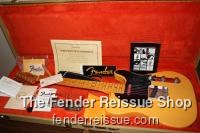
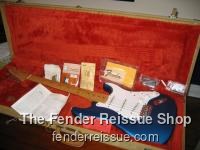
Below you'll find The Fender Reissue Shop's inventory of Corona-era American Vintage Reissue Stratocasters, including custom-color examples and rare-feature production from the most sought-after years.