Fender American Vintage Reissue (AVRI) Stratocaster: A Collector's Guide
Few production instruments have enjoyed the steady appreciation of Fender's American Vintage Reissue Stratocaster — a series Fender introduced in 1982 to recapture the spec, feel, and cachet of its 1957 and 1962 originals. For the better part of four decades, AVRI Strats served as the cornerstone of Fender's high-end production line, made first in Fullerton, California and later in Corona. They reward attentive collectors with documentable provenance, distinctive factory features, and a market that has matured considerably since the late 1990s. This guide is intended for the serious enthusiast: it covers the program's origins, how to authenticate an AVRI, the meaningful differences between the '57 and '62 specifications, the V-prefix serial number system, and the reasons these guitars continue to draw a deep collector base.
The Origins of the Fender Reissue Program
In late 1981 and early 1982, a new senior team at Fender — led by Bill Schultz with Dan Smith driving the product side — set out to repair the brand's reputation after a decade of declining quality. Their solution was as bold as it was conservative: rather than redesign Fender's classic instruments, they would faithfully reissue them. The Vintage Reissue line debuted in 1982 with three models: the 1957 Stratocaster, the 1962 Stratocaster, and the 1957 Precision Bass, each built to spec from blueprints, period-correct measurements, and surviving production tooling. By 1983 the line expanded to include the 1962 Precision Bass and 1962 Jazz Bass; the 1952 Telecaster joined shortly after. These instruments were the first Fenders in years that approached the build quality, tone, and feel of the originals — and they signaled a decisive turn away from CBS-era manufacturing. Most of these early instruments came from the Fullerton plant, which remained the company's main production site through the entire CBS period.
1957 vs 1962 Reissues: What Sets Them Apart
The two specifications were chosen to bracket the most-coveted years of original Stratocaster production: 1957, the late-maple-neck era of single-piece neck construction with a vintage soft-V profile and an alder body; and 1962, the slab-rosewood-board pre-CBS specification with a modern-C neck profile and clay-dot fretboard inlays. Collectors prize each spec for distinct reasons.
The '57 Reissue
Single-piece maple neck and fretboard, soft V profile, three '57-style single-coil pickups with staggered alnico magnets, eight-screw pickguard, three-way switch (later five-way after 1982), and a two-tone Sunburst finish in nitrocellulose lacquer were standard. Earliest examples — particularly Fullerton-era 1982 and 1983 production — exhibited "red bottom" pickups: their phenolic baseplates showed a distinctive red-pink hue rather than the gray bottom that became standard later. The all-maple neck construction, period-correct hardware, and authentic V profile make the '57 reissue the closest production-line approximation of a late-1950s Strat that Fender has ever offered.
The '62 Reissue
Maple neck with rosewood slab fingerboard, modern-C profile, and three '62-style single-coil pickups with the famous pre-CBS magnet stagger. The '62 reissue was offered in three-tone Sunburst as well as Custom Colors — Fiesta Red, Lake Placid Blue, Olympic White, Sherwood Green, Sonic Blue, Candy Apple Red, and others — making it the more colorful of the two reissues. Custom-color examples are now among the most sought-after Fullerton-era reissues on the secondary market, with rarities like Fiesta Red and Sherwood Green commanding serious premiums when documented and original.
How to Identify an Authentic AVRI Stratocaster
Authentication begins with the V-prefix serial number. Every American Vintage Reissue Stratocaster from 1982 onward carried a serial stamped on the neckplate (Fullerton era) or on the headstock (later Corona-era reissues), in the format Vxxxxxx. The number is sequential across all V-serial Fender instruments, not just Stratocasters — so a P-Bass and Strat in close production proximity can share neighboring serials. Authenticators cross-reference three pieces of dating information.
Neck Date
The neck heel of every AVRI is stamped or written with a date. In the Fullerton era this was usually a hand-stamped numeric date in the format M-D-YY (for example 5-13-82). Corona-era reissues moved to a printed format and later included a model code prefix. The neck date is the single most reliable piece of internal dating information for any reissue Strat.
Pot Codes
Underneath the volume and tone potentiometers you'll find a six- or seven-digit code from CTS, the original-equipment supplier. The first three digits (137 for CTS) identify the manufacturer; the next two are the year, and the last two are the production week. A pot stamped 1378245 was made in week 45 of 1982 and is consistent with a guitar shipped late 1982 or early 1983. Pots typically predate the neck date by one to four months because pots were stocked in batches.
Body Date and Hardware Signatures
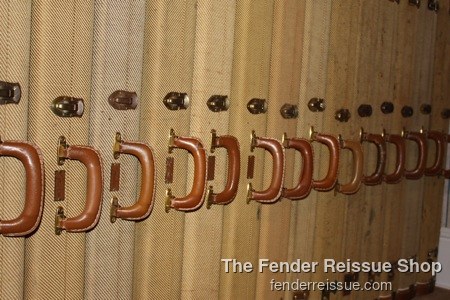
Removing the neck reveals a body date — usually written in pencil in the neck pocket. Original tremolo blocks should be cold-rolled steel; pickup-cavity routing should match the period-correct material. Original-issue tweed cases with full case candy add documentable provenance. Any guitar offered as an AVRI without consistent neck date, pot codes, and body date deserves additional scrutiny before purchase.
The V-Prefix Serial System and Era Estimation
V-prefix serials run sequentially from 1982 onward. As a rough field guide, serials in the V000xxx through V020xxx range correspond to Fullerton-era production (1982-1984), while V020xxx through V100000 and beyond correspond to Corona-era production from 1985 through the 1990s. Because the sequence is shared across Stratocasters, Telecasters, Precision Basses, and Jazz Basses, the most accurate year estimate comes from neighbor-bracketing — comparing your serial to documented examples on either side. The Fender Reissue Shop maintains a free AVRI serial number lookup tool that uses bracketed estimates from verified inventory and consistently outperforms any published serial-to-year chart.
Why Collectors Pursue AVRI Stratocasters
Three factors drive sustained collector interest. First, AVRI Strats are the most accurate production-line reissues Fender has built — closer in spec, build, and tone to the originals than any catalog model that came after them, including the American Original and American Vintage II series. Second, they are now themselves vintage instruments: a 1982 Fullerton-era reissue is, as of 2026, more than 40 years old, and many of the early features (red-bottom pickups, factory-routed pickup cavities, neck-pocket serial stickers) are documentable signs of pre-production transitional manufacturing. Third, prices for original 1957 and 1962 Stratocasters now exceed six figures, making AVRI reissues the only way most collectors can own a guitar built to those exact specifications. Fullerton-era examples in custom colors, with documented provenance and original case candy, regularly trade for several multiples of their original retail price.
Conclusion
The Fender American Vintage Reissue Stratocaster occupies a particular place in the modern collecting landscape: too young to be vintage in the strict sense, but old enough — and rare enough — that the best examples are no longer cheap, and won't be again. Whether you're authenticating a candidate, deciding between the '57 specification and the '62 specification, or just trying to make sense of the V-serial system, the same discipline applies: cross-check every piece of dating information, document everything, and prefer guitars whose history is verifiable. The AVRI Stratocaster line is one of Fender's most successful long-run products, and its best examples will remain quietly desirable for collectors who pay attention to the details.